10-K p.8, p.39. Only Equipment / Chemicals / Building Materials meet the ≥10% disclosure threshold; everything else (parts & accessories, commercial, Horizon irrigation & landscape) sits in "Other / unallocated."
10-K p.5, restated p.14. The 64% maintenance baseload is the thesis cornerstone.
Cells are estimates calibrated to POOL's published marginals (column totals = 14/31/12/43, row totals = 64/22/14). Useful for orientation; not company-disclosed. Cell values are % of total FY25 net sales.
Chemicals volume-led; equipment was "a very pleasant surprise" (CFO); Horizon -2% reflects discretionary landscape weakness. CFO confirms GM rank: Building Materials > Chemicals > Equipment, so the +7% equipment print mechanically diluted the blended GM by ~20 bps. Europe shown as +16% USD per 1Q26 deck p.4 — the call commentary only references +5% local currency; the USD figure includes a meaningful FX tailwind.
$1.7B at 3/31/26 driven by stocking for new locations, broader product range, mid-season vendor price increases, and opportunistic pre-season buys. Mgmt: "extremely healthy" profile concentrated in fast-movers.
Top 3 OEMs = ~43% of cost of goods sold. The single most concentrated exposure in the business and the structural rationale for POOL's private-label push (Regal, E-Z Clor, NPT, Xtreme Tab, bandless antimicrobial cartridge filter).
Seasonal pattern: Q1 (lowest) → Q2/Q3 (peak season) → Q4 (lower again). Mgmt cites FY-average to remove seasonality.
FY24 ≈ 12.5% → FY25 = 15% → FY26 target run-rate >15%.
Q3 25 hit 17% peak. Long-term target >25% per Arvan ("couldn't ultimately exceed 25% target and maybe higher").
Sources: Q1 24 = 11% (Q1 25 call p.4 comparison); Q2 24 = 14.5% (Q2 25 p.4); Q4 24 = 12.5% (Q4 25 p.3); Q1 25 = 12.5% (Q1 26 p.5); Q2 25 = 17% (Q2 25 p.4); Q3 25 = 17% all-time-high quarter (Q3 25 p.3); Q4 25 = 13.5% (Q4 25 p.3); Q1 26 = 13% (Q1 26 p.5). Q3 24 estimated ~13% (between adjacent data points; not directly disclosed in any retrieved call).
| Non-disc. | Semi-disc. | Disc. | Total | |
|---|---|---|---|---|
| Chemicals | $688 | $53 | <$25 | $740 |
| Equipment | $900 | $475 | $265 | $1,640 |
| Building materials | $53 | $370 | $212 | $635 |
| Other / unallocated | $1,745 | $265 | $265 | $2,274 |
| Total | $3,385 | $1,164 | $740 | $5,289 |
Row totals match POOL's disclosed product mix; column totals match the 64/22/14 end-market split. Cells are inferred from qualitative disclosures (Arvan pump/filter vs heater/light comment, building-materials use cases).
| Costing method | Moving-average cost (not LIFO/FIFO) |
| Inventory @ 12/31/25 | $1,454.7M |
| Inventory @ 12/31/24 | $1,289.3M |
| YoY growth | +13% |
| Inventory @ 3/31/26 | ~$1,700M |
| Build from YE | +$200M |
| Turns (trailing 4Q) | 2.7x |
| Implied days inventory | ~135 days |
| Obsolescence reserve | $23.9M (~1.6% of gross) |
| 2025 write-down provision | $4.0M |
| 2025 write-offs | $(6.7)M |
| ±20% reserve sensitivity | ±$4.8M pretax, ±$0.10 EPS |
POOL discloses only the 4-category top-level mix. Sub-products below are decomposed using three internal models already in this KB:
(1) Tier T1–T5 renovation-event framework [POOL_RevenueDrivers_Model.xlsx > Age_Cycle],
(2) manufacturer pull-through [Pool_Distributors_Data.xlsx > Mfr_PullThrough],
(3) LTV-per-pool decomposition [POOL_RevenueDrivers_Model.xlsx > LTV_Per_Pool].
Sub-category $ are calibrated so each row sums to the disclosed top-level total.
T1 (single equipment swap, 9-yr cycle) is the largest pool of revenue at $2.25B industry / $1.4B POOL. T4 major modernization is the highest-$/event at $18k. POOL captures ~62% of T1 (equipment-led) but only ~50% of T2–T5 (building materials face Heritage NPT + regional masonry).
Cleaner: 5 yr (fastest). Variable-speed pumps may stretch 30–50% past spec per Arvan. The 2010–2015 VS pump cohort is now hitting replacement — second wave from 2020–2022 COVID cohort hits 2028–2031.
New equipment that extends the replacement cycle is the most under-appreciated structural lever on POOL's T1 service revenue. Variable-speed pumps (replacing single-speed, 2010→present) and LED lights (replacing incandescent, 2008→present) both stretched useful life by 30–80% and deferred billions of $ of replacement demand. Both are now reversing — first-wave installs from 2010–2015 are hitting end-of-life.
| Single-speed (legacy) | Variable-speed (current) | |
|---|---|---|
| Spec replacement cycle | 7–10 yr (avg 8) | 10–15 yr (avg 12) |
| Actual stretched life | 8–10 yr | 12–18 yr (Arvan: "30%, 40%, 50%" past spec) |
| Wholesale unit cost | $300–500 | $700–1,100 |
| Annual energy cost | $800–1,500 | $250–500 |
| Regulatory inflection | — | DOE July 2021 mandate >1 THP |
| Installed base today | ~55% | ~45% (and growing) |
| Next wave | late SS cohort EOL | 2026–2030 (first VS wave) |
The cycle extension cost POOL ~$100M/yr of pump revenue during the transition. First-wave VS pumps (2010–2015) now reaching 11–16 yr in service → replacement starts now.
| Incandescent (legacy) | LED (current) | |
|---|---|---|
| Fixture cycle | 10–15 yr | 8–12 yr (entire fixture) |
| Bulb cycle | 1–2 yr (constant) | none (sealed) |
| Wholesale fixture cost | $80–150 | $200–400 |
| Wholesale bulb cost | $25–60 each | n/a |
| 10-yr TCO | ~$400 (fixture + 5–8 bulbs) | ~$300 (fixture only) |
| Installed base today | ~65% | ~35% |
| Next wave | incandescent EOL conversions | 2025–2030 (first LED wave + conversions) |
The bulb-replacement category was a $40–60M/yr POOL line that collapsed to <$5M as LED took over. Fixture revenue is bigger per event but 30% less frequent. Net upcycle ahead from the conversion-of-legacy + first-LED-wave double.
Pumps: gradual 2010–2020, mandate 2021. Lighting: faster S-curve 2010–2020. Note: % of new installs, not % of installed base. Installed-base mix lags by ~7–10 years due to slow turnover.
Pumps still 55% single-speed → 45% VS conversion runway. Lighting 65% incandescent → big LED conversion opportunity in remodels. Salt systems 40% penetrated. Heat pumps only 15% — long runway.
Installed-base age modeled from POOL_RevenueDrivers_Model.xlsx > Age_Cycle: each pool of age A with cycle C has been replaced floor(A/C) times; current unit age = A mod C, weighted by cohort size.
| Component | Legacy tech | Current tech | Legacy cycle | Current cycle | Δ cycle | Installed base mix | Avg age in service | Next wave | $ direction |
|---|---|---|---|---|---|---|---|---|---|
| Pump | Single-speed | Variable-speed | 8 yr | 12 yr | +50% | 55% SS / 45% VS | ~7–9 yr | 2026–2030 | ⬆ |
| Lighting | Incandescent | LED | 12 yr fixture + 1.5 yr bulb | 10 yr fixture | +20% fixture / kills bulb cycle | 65% incand / 35% LED | ~10–12 yr | 2025–2030 | ⬆ |
| Heater (gas) | Atmospheric millivolt | Electronic ignition | 8–10 yr | 10–12 yr | +20% | 85% current / 15% legacy | ~7 yr | ~10%/yr | → |
| Heater (heat pump) | n/a | High-efficiency HP | n/a | 12–15 yr | n/a | 85% gas / 15% HP | varies | gas→HP swap | ⬆ |
| Filter (sand) | Standard | High-rate | 15–20 yr | 15–20 yr | flat | 70% current / 30% old | ~10 yr | ~5%/yr | → |
| Filter (cartridge) | 50–200 sq ft | Bandless antimicrobial | 10–12 yr | 12–15 yr | +20% | 95% std / 5% new | ~6 yr | ~7%/yr | ⬆ slight |
| Filter (DE) | Standard | Standard | 15–20 yr | 15–20 yr | flat | 95% legacy | ~10 yr | ~5%/yr | → |
| Salt chlorinator (system) | n/a (chlorine tabs) | Salt cell + control | n/a | 7–10 yr | n/a | 60% tabs / 40% salt | ~6 yr | ~12%/yr salt base | ⬆ |
| Salt cell (consumable) | n/a | Replaceable cell | n/a | 3–7 yr | n/a | (consumable) | n/a | continuous | ⬆ recurring |
| Automation | Mechanical timeclock | Smart system | 15–20 yr | 10–12 yr | −30% (faster!) | 50% timeclock / 50% smart | ~8 yr | 2024–2030 | ⬆ |
| Cleaner (suction) | Standard | Standard | 5–8 yr | 5–8 yr | flat | 95% legacy | ~3 yr | ~15%/yr | → |
| Cleaner (pressure) | Standard | Standard | 6–10 yr | 6–10 yr | flat | declining | ~5 yr | ~12%/yr | → |
| Cleaner (robotic) | n/a | Robotic | n/a | 5–8 yr | n/a | 30% robotic / 70% suction/pressure | ~4 yr | continuous, premium | ⬆ |
| Interior — plaster | White plaster | White plaster | 10–15 yr | 10–15 yr | flat | ~50% of new | ~10–14 yr | ~7%/yr | → |
| Interior — pebble | n/a | Pebble Tec / StoneScapes | n/a | 15–25 yr | +50–80% vs plaster | ~50% of new | ~10 yr | spread later | ⬇ slower events |
| Interior — quartz | n/a | Quartz aggregate | n/a | 12–18 yr | +20% vs plaster | small / growing | <8 yr | spread later | → |
| Vinyl liner | Standard vinyl | Heavyweight virgin | 7–10 yr | 8–12 yr | +20% | ~5% of inground | ~6 yr | ~12%/yr | → |
| Pool cover (manual) | Tarp | Mesh safety cover | 5–8 yr | 8–12 yr | +50% | 60% mesh / 40% legacy | ~5 yr | ~12%/yr | → |
| Pool cover (auto) | n/a | Track + motor | n/a | 15–20 yr / 5–7 yr fabric | n/a | <5% | varies | continuous fabric | ⬆ slight |
| UV / ozone sanitizer | n/a | Supplemental UV/O3 | n/a | 3–5 yr bulb / 10–15 yr unit | n/a | ~95% chlorine only | n/a | adopting base | ⬆ new category |
The convergence argument: 5 of 6 major equipment categories are entering simultaneous replacement waves (VS pumps + LEDs + smart automation + salt cells + robotic cleaners). Layered on the 314k COVID-cohort pool installations from 2020–2022 that hit 7–10yr equipment service starting 2027–2030, the equipment line should accelerate beyond mgmt's current "flat-to-modest" guidance even with new construction stuck near 60k starts/yr.
Pumps lead at ~28% ($460M). Top suppliers per category: Pumps (Pentair IntelliFlo, Hayward TriStar) · Heaters (Pentair MasterTemp, Raypak) · Automation (Pentair IntelliCenter, Hayward OmniLogic) · Cleaners/Robotics (Maytronics Dolphin).
Sanitizers (trichlor, cal-hypo) = 50% / ~$370M. Private-label (Regal, E-Z Clor) penetration estimated 30% of chemical $, materially higher than equipment private-label.
Interior finish (plaster, pebble, StoneScapes) is 40% / ~$255M. NPT-branded share estimated 60-70% of interior finish, 50% of BM overall. NPT rebrand Nov 2025: "National Pool Tile" → "National Pool Trends."
Parts & accessories at $910M is the biggest single chunk and has ~100k+ SKUs alone. Horizon irrigation/landscape (~$680M, 92 of 476 locations) is the largest non-pool segment buried in "other."
Parts & accessories = 110k SKUs (55% of catalog) but only 17% of sales. Equipment = 12k SKUs (6%) but 31% of sales. Top ~30k SKUs drive ~75% of revenue. This is the structural rationale for POOL360 — automate the tail.
Equipment is 31% of sales but ~38% of inventory $ (slowest-turning category). Chemicals = 14% of sales but only ~7% of inventory $ (fastest turn at 5.0x). The +$200M Q1 inventory build is concentrated in equipment positioning for the season.
| Sub-category | Non-disc. | Semi-disc. | Disc. | Total sales | Inv. $ | Turns | DIO |
|---|---|---|---|---|---|---|---|
| EQUIPMENT | $900 | $475 | $265 | $1,640 | $555 | 2.0x | 183d |
| Pumps | $320 | $95 | $45 | $460 | $165 | 2.0x | 183d |
| Heaters | $165 | $145 | $50 | $360 | $130 | 2.0x | 183d |
| Filters | $160 | $50 | $20 | $230 | $80 | 2.0x | 183d |
| Automation / lighting / cleaners / salt | $255 | $185 | $150 | $590 | $180 | 2.0x | 183d |
| CHEMICALS | $688 | $42 | $10 | $740 | $100 | 5.0x | 73d |
| Sanitizers + Balancers + Algaecides | $580 | $12 | $0 | $592 | $80 | 5.0x | 73d |
| Specialty + Salt | $108 | $30 | $10 | $148 | $20 | 5.0x | 73d |
| BUILDING MATERIALS | $53 | $370 | $212 | $635 | $200 | 2.2x | 166d |
| Interior finish (plaster/pebble) | $0 | $165 | $90 | $255 | $80 | 2.2x | 166d |
| Tile / coping / deck / misc | $53 | $205 | $122 | $380 | $120 | 2.2x | 166d |
| OTHER / UNALLOCATED | $1,744 | $277 | $253 | $2,274 | $600 | 2.7x | 135d |
| Parts & accessories | $720 | $130 | $60 | $910 | $260 | 3.8x | 96d |
| Horizon irrigation & landscape | $530 | $80 | $70 | $680 | $190 | 2.5x | 146d |
| Commercial pool products | $200 | $30 | $20 | $250 | $90 | 1.8x | 203d |
| Non-equip cleaners + NPT hardscapes + other | $294 | $37 | $103 | $434 | $60 | 3.0x | 122d |
| TOTAL | $3,385 | $1,164 | $740 | $5,289 | $1,455 | 2.7x | 135d |
| Granularity desired | Why blocked | Possible path |
|---|---|---|
| Actual SKU-level inventory $ | POOL Note 12: "impracticable" | Dealer credentials on POOL360 (ToS concerns) |
| Purchase-order frequency & $ | Entirely private | Channel-check via former POOL employees on AlphaSense |
| Brand-level rev within equipment (Pentair/Hayward/Jandy split) | Not disclosed at POOL level | Triangulate from supplier 10-Ks (already in Mfr_PullThrough tab) |
| Private-label $ | Mentioned narratively only | Investor Day push (May 12, 2026) |
| Inventory by sales center | Never disclosed | Not scalable |
| Customs/import data (Chinese trichlor, Pentair Mexico) | Available via Panjiva / ImportGenius | Subscription paywall |
| Real-time POOL360 inventory levels | Dealer-portal-only | Not pursuable through public means |
Management quotes now live in their own tab —
Interactive map (folium). Source: Unison_KB/dashboards/pool_locations/locations.csv built from poolcorp.com/map_api/map.php May 2026 pull. Reconciliation: 10-K reports 456 sales centers at 12/31/25 (which INCLUDES the 19 NPT dedicated sales centers — per 10-K p.4); locator shows 476 entries worldwide. Gap of ~20 is a mix of international franchisee-affiliated, very-recently-opened, or in-transit entries. Mgmt's quarterly KPI is the 455 figure (one consolidation reduced 456→455 in Q1 26).
Horizon (POOL's irrigation & landscape banner, ~13% of FY25 sales as "Other") grew from 76 to 88 US sales centers (+12 / +16%) over the past 5 years. Sand-state concentration intensified: 72% → 75% of Horizon's footprint (FL+CA+TX+AZ), driven by the TWC Distributors acquisition (Dec 2020, 10 FL+GA locations) and TX greenfield wave 2022-2023. Recent years (2024-2025) show rationalization — net closures (-3 each year) in FL and TX as POOL consolidates underperforming branches.
FL: 13 → 17 (TWC 2020) → flat 17 through 2024 → 16 in 2025. CA: steady organic +3 over 5yr. TX: 16 → 22 peak FY23 → consolidated back to 18 by FY25 (-4 from peak). AZ: 9 → 12, including Pro-Water acquisition Mar 2023 (+2).
76 → 81 (TWC integration) → 88 → 92 peak FY23 → 90 → 88. The FY23→FY25 rationalization is a deliberate "focus on driving more value from existing network" per Q4 25 commentary — same theme as the slower SCP/Superior greenfield pace.
| State | FY20 | FY21 | FY22 | FY23 | FY24 | FY25 | Δ (5yr) |
|---|---|---|---|---|---|---|---|
| CA | 17 | 18 | 19 | 19 | 20 | 20 | +3 |
| FL | 13 | 17 | 17 | 17 | 17 | 16 | +3 |
| TX | 16 | 16 | 20 | 22 | 20 | 18 | +2 |
| AZ | 9 | 9 | 9 | 11 | 11 | 12 | +3 |
| Sand subtotal | 55 | 60 | 65 | 69 | 68 | 66 | +11 |
| WA | 6 | 6 | 8 | 8 | 8 | 8 | +2 |
| OR | 4 | 4 | 4 | 4 | 4 | 4 | 0 |
| NV | 3 | 3 | 3 | 3 | 3 | 3 | 0 |
| VA | 3 | 3 | 3 | 3 | 3 | 3 | 0 |
| ID | 2 | 2 | 2 | 2 | 2 | 2 | 0 |
| NC | 1 | 1 | 2 | 2 | 1 | 1 | 0 |
| CO | 1 | 1 | 1 | 1 | 1 | 1 | 0 |
| GA | 1 | 1 | 0 | 0 | 0 | 0 | -1 |
| TOTAL US | 76 | 81 | 88 | 92 | 90 | 88 | +12 |
Reconciliation note: 10-K reports 88 Horizon at 12/31/25; locations.csv shows 92. The 4-loc gap is likely recent additions / regional depots in the customer-facing locator not yet in the audited 10-K Properties table.
"...as a couple of pieces of equipment transition to longer life items. So like when the industry moved from single-speed pumps to variable speed pumps, by their very nature, variable speed pumps last longer, sometimes up to 2x longer than a single-speed pump. So if you go back to 2018 when that regulation went into effect, then you just do the — you extend out the life of a variable speed versus single speed, those variable speed pumps that were installed very early on in the transition that would have gone well past the normal life of a single-speed pump. Those will now start coming into the replacement cycle, we believe that."
"The expected life of equipment varies tremendously, based on what the product is and the operating conditions that it's used, whether it's in a seasonal market or whether it's in a year-round market, and whether the product is properly maintained or not and with weather events. In general, part of the value proposition of a variable speed pump is that it runs instead of that full rate under full load all the time. It runs at a lower load which extends the life. It could extend the life by 30%, 40%, 50%, it really depends on many, many other factors. But in general, it has extended the life span of pumps. It doesn't really have much of an impact on filters or anything like that."
"...if you look at LED light bulbs for the pool, those certainly on an apples-to-apples basis are going to outlast an incandescent. So since the time that both of those products were introduced we see that there should be opportunity for that replacement market coming up."
"Analysts probed for sizing of the VS-pump replacement wave 2028–2032. Management response: directional tailwind, hard to quantify yet."
Three observations to flag: (1) Heritage is NEVER mentioned by name in any of 5 calls — competitive references stay generic ("newer folks who have entered the market"); a deliberate non-acknowledgment of the share-shift narrative the AlphaSense experts confirm. (2) The replacement-cycle thesis only became management's explicit talking point at Q4 25 — meaning the structural offset to new-construction softness is a NEW narrative element from FY25 reporting onward. (3) Guide trajectory shows real conservatism: Q2 25 was the one cut, and Q1 26 deliberately did NOT raise FY26 despite the beat.
Long-tenured executive at one of POOL's top-3 equipment suppliers (Hayward = 11% of FY25 POOL COGS). Speaks from a manufacturer's perspective on channel dynamics, distributor incentive structure, and the Heritage share-shift narrative.
🔒 Full PDF held internally (AlphaSense ToS)A direct POOL customer. First-cut spend estimate of 65% POOLCORP "but it is changing" (revised to ~20% later in interview when scope clarified — interpret as POOL share of his current incremental purchasing is dropping fast). Speaks from a builder's perspective on local market dynamics, vendor relationships, and the "competing with the hand that feeds them" channel conflict risk.
🔒 Full PDF held internally (AlphaSense ToS)"There's a share shift going on from POOLCORP to Heritage. Heritage is successfully gaining market share. The issue for Heritage is they have many fewer locations than POOLCORP, like maybe a third. To the extent they can continue to open branches, you would infer from that that they can continue taking market share, but where they currently operate, they're successfully taking market share. I hear it regularly among the contractors that I'm familiar with."
"They've taken a lot of people, surprisingly. They've transitioned key individuals... They were hiring very high-level, influential people out of the POOLCORP organization a few years ago and I think that that had some meaningful impact. I think they have promoted themselves very heavily at industry events. They do a lot socialization. They hold concerts and bring people."
"They really present themselves and I think it's an actual persona of the management team as people you would sit down and have a beer with. If you're a guy with one truck or you build 12 pools a year, you look at them as people you can identify with. POOLCORP is much more of a corporate persona... I also think Heritage has used price. I think they have sharpened their pencil and given a little bit of additional price. If they're the kind of people you might like to have a beer with and they give you a little bit of price, you start buying over there."
"Heritage has been very, I don't want to say aggressive, but very accommodating. They've been price matching very well and have just really done a good job at staffing their branches. I think the overall morale at Heritage has gotten really good in the last couple years. They've got real good management and a very, very good culture. I see them doing very well in the near future and being more and more of a competitor for SCP and POOLCORP."
"When the smaller contractors make that decision, it's so subtle, you don't even know it. They just stop showing up to the store as often to the branch. It's also not a contractual change. What if they just move half their business? What if they do it when it's convenient? The moves are very subtle. They're hard to then react to."
"I think where POOLCORP needs to be concerned is they're starting to make and manufacture their own equipment. They're also getting into the pool service industry, which means they're competing with their customers. I don't think that's a good move for them. Therefore, that has made us question some of the orders that we have placed with them."
"I wouldn't say it's completely changed the way that we purchase. I know it's changed the way other people in my market have purchased, but we aren't quite there yet. We're on a high alert for it. It gives us a bad taste in our mouth knowing that they are potentially going to compete with us. We also don't understand why they want to start getting into manufacturing pool equipment because that seems like they're competing with even more of their clients."
"I also think that they need to take a step back sometimes and not try to do too much and compete with the hand that feeds them."
"The reason POOLCORP doesn't want to own stores, and I don't think Heritage would either, is because they don't want to be perceived as a competitor to their customers. Their customers are pool professionals that come in and buy chemicals and equipment and so on. If you're running a store that competes with that person, it drives a wedge."
"In 2019, a typical pool being built, the opening price point pool had a single pump, a filter, a light, maybe automation. It probably had $4,000-$5,000 in manufacturer revenue of the equipment. A pool now has $15,000-$17,000 worth of manufacturer equipment. It's not all inflation. It's content, it's automation, it's ultraviolet light sanitization, it's chlorine generation from salt pools, it's LED lighting is tremendous."
"Variable speed pumps were starting to take hold. They're much higher ticket, they're probably 5X the cost of an old pump, the pump that existed in 2018."
"In fact, I think that's somewhat of a sales tool that is dying. It used to be a way to help sell pools, but everybody uses variable speed, low-energy pumps now."
"They're upgrading to more automated sophisticated systems... I think the majority is probably convenience and overall control and being able to monitor the chemical usage and water usage. I think a lot of it is the data behind the automation."
"There's another issue... about 60,000 in-ground pools are retired every year. Filled in, done away with... That means the net growth in pools is de minimis."
"I think we have about 62,000 pool builds now in the U.S. which is a very, very low historical number. You would bet on the upside for that, but not substantially. I think if there were consensus, that consensus would be that normalized starts in a reasonable economy, market economy, would maybe be about 75,000. It's not like we're going to go from 62 to 100. We're not going to see dramatic shifts in pool building."
"When you look at POOLCORP or anything in the pool space, it's very well-pronounced that we have a strong aftermarket, strong R&R. It's the underpinning. It's 80% of the business. It probably is slightly more than 80% today."
"The average pool, if you're trying to put in a, I don't want to say basic, but a normal, traditional opening price point swimming pool, it's well over $100,000 now. That number, I think when I started in the industry probably was $60,000 or maybe just under $60,000... I really think that's the economic dilemma the pool industry faces is that middle America can't really afford the house and the pool. If the choice has to be made, it's house."
"We're starting to come to terms with the idea that they don't [have cash] and that pools are going to be for a higher earning segment of the population than they once were. The pools that we're seeing built in that 62,000 population, the majority are higher end pools. There are people of means and wealth that can easily afford to buy a pool, and therefore they're buying a higher value pool even than the opening price point. A $300,000 pool, a $400,000 pool, not terribly uncommon."
"I think this part of Texas is still a very sought-after place to live and grow a family. There's a big business influence as well and big tech hub. We have pretty decent weather and good business policies. With all that, I think we're still going to have the higher end affluent people continuing to move here... and every one of them wants a pool because it's Texas and it's hot."
"The pool industry very successfully passes price to the market, very successfully and not in insignificant numbers. In the peak of COVID yes, inflation was enormous. The pool industry was able to push all that price through the distribution channel. Accepted it almost gleefully because they just pass it through and add their margin."
"It's a very rare point in history that pricing moved less than 2%. Very rare. I have to take the COVID years out, but just this year it was probably, I don't know, 6%."
"Are you aware there were two significant chlorine production interruptions, not just COVID related. There was a fire and 2X in a chlorine production facility in the U.S. which caused people to hoard chlorine. Chlorine prices went crazy... I think the deflation in chemicals is probably that coming out... I don't think the chemicals can continue to deflate for five years."
"Different manufacturers and different items by the manufacturer went up differently. Some stuff, anywhere from 3% to I think upwards of 20% on certain items, maybe heaters... I think in a whole, I would say probably 5%-7%."
"It's not differentiated. There are some insignificant differences. POOLCORP can take more advantage of special incentives and promotions like the early buy, they can commit to larger orders... The day-in, day-out acquisition cost of the goods is undifferentiated."
"It's all rebate driven. Whatever they acquire in the given year, they get a rebate that's double digit. It's substantial. Bigger you are, the more it is. The more strategic you are, the more it is. That's where the real competition exists."
"They're indifferent to which line of equipment they sell. A manufacturer has to spend tremendous resources downstream from the distributor to create demand. We have to go call on all the builders, we have to see the service contractors, we have to promote the goods, we have to train. The distributor just services the business that comes through... If you walk into a POOLCORP branch and ask for a Pentair pump, they're just going to give it to you. They're not going to say, 'Have you seen the new Hayward pump?'"
"There's just nothing in the DNA of a manufacturer that wants to disintermediate the channel in the U.S. predominantly because you just have two big distribution platforms and if you alienate them in any way, the risk of them pulling your line is too great."
"POOLCORP claims that it's 60%-80% picked up. The pool professional, probably because of their fragmented nature, maybe because the aftermarket is so significant and you're not shipping mass quantities, just one pump here, one thing there, it's 60%-80% picked up. The branch becomes an important thing."
"It should be good. They've invested in it for a long period of time. I think all those digital tools are helpful and potentially differentiating. The dynamic of having 70% of the volume going as walk-in customers, I think pushes back against digital tools to some extent... Home Depot will deliver to my home a $20 item within three or four hours. That type of service is excellent... pool360 can offer some of that, except their model is not to deliver."
"I think they can offer better pricing, more consistent pricing. I think that they need to make sure their online POOL360 portal is updated to the most recent builders pricing because we have found where pricing on the website is not accurate for what my deal is with the distributor, depending on what our kickbacks are."
"It wouldn't surprise me if Pool and Landscape was divested. It's not really core. It's certainly not core to SRS and construction materials... They probably have to spin it to their shareholders. They could IPO it. POOLCORP could not buy it... Ferguson would be a really interesting play, expanding their presence in the water and plumbing side. That would be really interesting."
"I think it's actually good for POOLCORP to have Heritage. Frankly, they need someone to chase. In the years leading up to that they were dominant. They were making all the acquisitions. No one else was acquisitive. Sometimes a business can get to a point where, I don't know, it's a little too easy and they're overconfident."
"I live in Florida. There are many pool distributors here, many branches. There is not a Heritage branch near me. There is a POOLCORP branch 20 minutes away. I would go over an hour to get to a Heritage branch. In my community, no one's buying from Heritage. If they opened a branch, I'm sure they would take share, at least initially. New guy in town."
"POOLCORP has not expanded Pinch A Penny very much, 10 or 12 stores a year. I don't think it's easy to find franchisees."
"I think the do-it-yourself pool service has diminished some. I think the pool market is very, very flat."
"Our growth thesis does not require a recovery in new pool units. It is anchored in maintenance, remodel and share capture across product categories for the existing installed base."
"New pool units for 2025 came in at 58,000. While we expect 2026 will be close to that level, it is important to remember that the center of gravity of our business is the 5.5 million in-ground pools already installed."
"A pump and a filter, non-discretionary. If those need to be replaced or repaired, they have to be replaced or repaired. But you get into heaters and/or lights, something like that. If somebody doesn't want to fix that... you don't actually have to have that to continue to safely operate the pool. So in some areas, that's where we have seen some decline in demand. But I would tell you that, that's already in and baked in."
"Chemicals grew 8% on strong volume with standout contributions from our proprietary and private label lines, which carry structurally higher margins and are gaining traction across the enterprise."
"Building materials having the best margin and then after that would be chemicals, and then after that would be equipment."
"Equipment sales grew 7% in the quarter and given the lower relative margins of this category, the strong volume performance diluted consolidated gross margin. We view this growth as strategically positive."
"The profile is what I would characterize as extremely healthy. We're actually very astute buyers when it comes to buying inventory... they're sitting in very high moving items. So I really — from an inventory perspective, I spend very little time worrying about the inventory levels."
"Stocking for new locations and acquisitions added to the network, new product introductions resulting in a broader product range and cost inflation relative to the same period last year, with some opportunistic purchases made ahead of current season price increases."
"I wouldn't want anybody to position our private label as a down price offering... we're trying to have an offering that has tremendous value and is very high quality."
"[An example is] a proprietary bandless antimicrobial cartridge filter, which is much faster to service and has a very low micron filtration rate, helping produce clearer pools and complementing LED lights which are getting brighter."
"I don't see any reason why the company couldn't ultimately exceed 25% target [POOL360 penetration] and maybe higher in the future."
"This was the year of continued industry developments, shifting demand patterns, persistent customer uncertainty, and evolving customer expectations."
"In 2025, we estimate that just under 60,000 new pools were built in the U.S. amid single-digit decline from last year. This is about half of what we saw at the height of the pandemic and 40% lower than in 2022."
"We estimate that maintenance items accounted for roughly 64% of our pool product sales, while renovation and remodel projects made up 22%, and new pool construction contributed 14%."
"There's a couple of things that we're going to start to see benefit from as it relates to equipment. So when the industry switched from single speed motors to variable speed motors, they inherently lasted longer, but now we're starting to get close to the period where from when we started selling a lot of single speed motors or single speed pumps to variable speed pumps, that they will start coming into their replacement cycle, number one."
"Number two, I still believe that there is a significant opportunity to modernize the pad. If I looked across the, we talked to many, many customers, we talk about what they're seeing in the backyard when they go into these backyards and they look, if what we were seeing over and over again was ultra-modern pads are fully adopted everything that is available to the consumer, I would say, okay, so now we're more in a replacement cycle, but today what I would say is there is still an outsized opportunity to modernize the pads with the new equipment."
"Chemicals were down 1% for the year, mostly due to price, and 3% in the fourth quarter... Building Materials finished flat for the year and were up 4% in the fourth quarter, driven by demand for our national pool trend products... Equipment sales, excluding cleaners, were flat year-over-year and down 3% in the fourth quarter, cycling against prior year hurricane recovery comps. Commercial pool products rose 3% for the year."
"Inventory at year end was $1.45 billion, an increase of $165 million or 13% from last year's balance of $1.29 billion."
"Inventory, as we have done successfully in the past, we acted opportunistically to secure pre-price increase purchases. This proactive investment positions us to protect and expand our gross margins."
"Digital sales reached 13.5% of total revenue in the fourth quarter, up from 12.5% last year and peaked at a record 17% during the pool season. For the full year, we finished at 15% of sales, which is an all-time high."
"With all these factors in mind, our diluted EPS range for 2026 is $10.85 to $11.15."
"We delivered our commitment to shareholder returns, distributing $530 million in cash this year, a 10% increase over last year. This includes $341 million in share repurchases and a 4% increase in our quarterly dividend."
"Assuming we achieve low single-digit growth revenue, incentive-based compensation expenses are projected to rise by $10 million to $15 million."
"I'm excited to share that our teams have maintained the momentum we established in the second quarter, delivering another solid performance in Q3... This was fueled by consistent maintenance activity and encouraging signs of stabilization in both new pool construction and remodel."
"I'm also pleased to see that we achieved year-over-year growth in building materials for the first time since Q3 of 2022, driven by improvements in remodel activity and share gain."
"Total chemical sales declined 4% this quarter, reflecting some additional deflation... Building materials sales increased 4%, again driven by our expansive private label offering... Equipment sales, which excludes cleaners, increased 4% during the quarter, mostly reflecting benefit from price and steady replacement volume for critical components."
"We recently rebranded NPT, formerly National Pool Tile to National Pool Trends to align our brand name and marketing efforts..."
"Of course, every new pool gets a set of equipment. A portion of the renovation and remodel will get — we'll get new equipment, but the vast majority of the products that we sell are related to a — one of the critical components on the pool failed and had to be replaced, whether it was a pump or whether it was a heater or filter, lights."
"Sales through the tool represented an all-time high of 17% of our total sales for the third quarter, which demonstrate the customer's desire for technology that creates value."
"We were at 17% for the quarter, which is an all-time high for us. We have people that are nearly double that... Do I think we could be as a company 25%, 30%? Yeah, I think we could — I think we absolutely could do that."
"We realized a 3% benefit from pricing, reflecting the full-quarter impact of price realization on the mid-season vendor price increases implemented in April and May. Trichlor selling prices continued to be impacted by the lower level of spend in the industry."
"We were very pleased to see positive sales growth in the second quarter, along with stable gross margins and steady operating margins versus the prior year. Given all the challenges affecting the broader economy and industry dynamics, I consider these results to be very solid."
"Without an interest rate cut, that will address the greater housing market. I think it would be tough to say that we believe that new pool construction is going to rebound this year."
"One of the shining stars is the fact that the maintenance and repair business of the growing install base is still very resilient. People still love their pools."
"Our parts sales are outpacing total sales growth in almost every market. So I think that there are some trade-offs being made with, well, can I fix it versus replace it?"
"If your pump has failed, whether your pump is 10% more or 5% more or 2% more than it was last year, I really think it's irrelevant. You have to replace the pump."
"Chemicals, specifically Trichlor, are seeing selling prices less than what we saw in the second quarter of prior year. This pricing, although lower than last year, still represents a significant premium over 2020."
"POOL360 platform transactions now represent 17% of net sales, up from 14.5% last year, reflecting enthusiastic customer adoption and creating durable competitive advantages that are hard to replicate."
"In the absence of an interest rate cut or external catalyst, we are updating our diluted earnings per share guidance for the year to a range of $10.80 to $11.30, which includes a $0.10 realized benefit from the ASU year-to-date."
"At the time of our last call, there appeared to be some signs of macro stability approaching, but we have seen the challenging economic environment continue to weigh on new pool construction and, to a lesser degree, renovation activities."
"Since our last earnings call, our largest equipment vendors announced and implemented an in-season price increase that ranged from 3% to 4% that took effect in April to address the March tariff announcements, and we increased our selling prices accordingly. We observed similar patterns during the pandemic years, and those increases passed through the channel with no reversals."
"Our exposure to direct imports in total is relatively small and would amount to less than 1% of revenue... The biggest tariff impact in our business is being felt in the equipment area, where the manufacturers have exposure for whole goods or components that are impacting their costs."
"As a rule of thumb, we look at equipment and say for every pump we would sell for a new pool, we probably sell four for repair and maintenance."
"People are still very tech, the demand for tech for new pool equipment, especially if somebody's going to spend that kind of money to replace something that should have a 10-year lifespan, they're not looking to go backwards and say, hey, give me old technology and mechanical time clocks and no automation."
"The competitiveness from a price perspective is nothing new. Most of our competitors that we have, whether it's the newer folks that have entered the market or the traditional players, in terms of their value proposition to the market, don't have what we do. So the way that they compete with POOLCORP is they walk in and say, whatever POOLCORP is selling you for, we will sell it to you for less."
"We saw some instances of aggressive competitive pricing for certain orders that appears to be in response to continued softness in the market."
Long-term sales growth algorithm: 6–9%. Composition: 4–6% industry growth (1–2% inflation + 1–2% installed base + 1–2% new construction) plus 2–3% from above-market growth (new products + share gain + Pinch A Penny + acquisitions). Bear case today: installed-base growth has slowed to ~0.7% and new construction is at trough.
Gross margin: ~30% steady-state (vs ~29% historical — 50bps benefit from Pinch A Penny, balance from supply chain + private label). Operating margin: ~20bps annual expansion target, ~13% long-term. Capex 1.0–1.5% of net sales. M&A $25–50M/yr in bolt-ons. Cash conversion ~100% of net income.
$37B "relevant POOL TAM": US Residential Pool $12B + US Commercial $2.4B + US Irrigation/Landscape $16B + US Hardscapes $3B + International $3.6B. POOL share on the broad TAM = ~14% (FY24). On the cleaner US 2-step pool wholesale base (~$7.25B), POOL share is ~63%.
Industry growth from $10B (2019) to $12B (2024) — a ~3.7% CAGR. POOL grew from $3B (2019) to $5.5B (2023) — meaningfully outpacing the market and demonstrating share gain. Operating margin: 10.7% (2019) → 13.5% (2023).
20% of branches operate at >20% operating margin | 35% at 16–20% OM | 33% at 10–15% | 8% on the "Focus List" <10% | 4% are new/acquired <12 months. Management explicitly targets getting most branches to 20%.
Pricing power vs. Heritage; risk of Home Depot direct disintermediation. Arvan response: "no new competition, just a roll-up" — POOL's tech, tenure, and supplier relationships not replicable by Heritage at the same speed.
Expansion of private-label into equipment? Arvan: no — POOL won't compete with its largest suppliers. PL stays in chemicals + building materials. This is the structural constraint on the Pentair/Hayward/Zodiac (43% of COGS) concentration risk.
CSL (centralized shipping location) network optimization; case for adding facilities in Texas/Nevada like the Clearwater FL plant. POOL currently runs 4 CSLs in the US + 1 in Europe.
The Investor Day 2024 narrative is increasingly stretched. Management has not abandoned the 6–9% long-term algorithm, but the FY26 guide ($10.87–$11.17 EPS) implies only 2–3% growth. The Q1 2026 beat ($0.10) was NOT used to raise the full-year guide — a signal of caution about the back half despite the early momentum. The replacement-cycle quotes (above) are the most recent and most specific articulation of the structural offset to new-construction softness. Watch the next two prints (Q2 July 23, 2026 + Investor Day May 12, 2026 follow-up) for whether the equipment replacement wave starts showing in numbers.
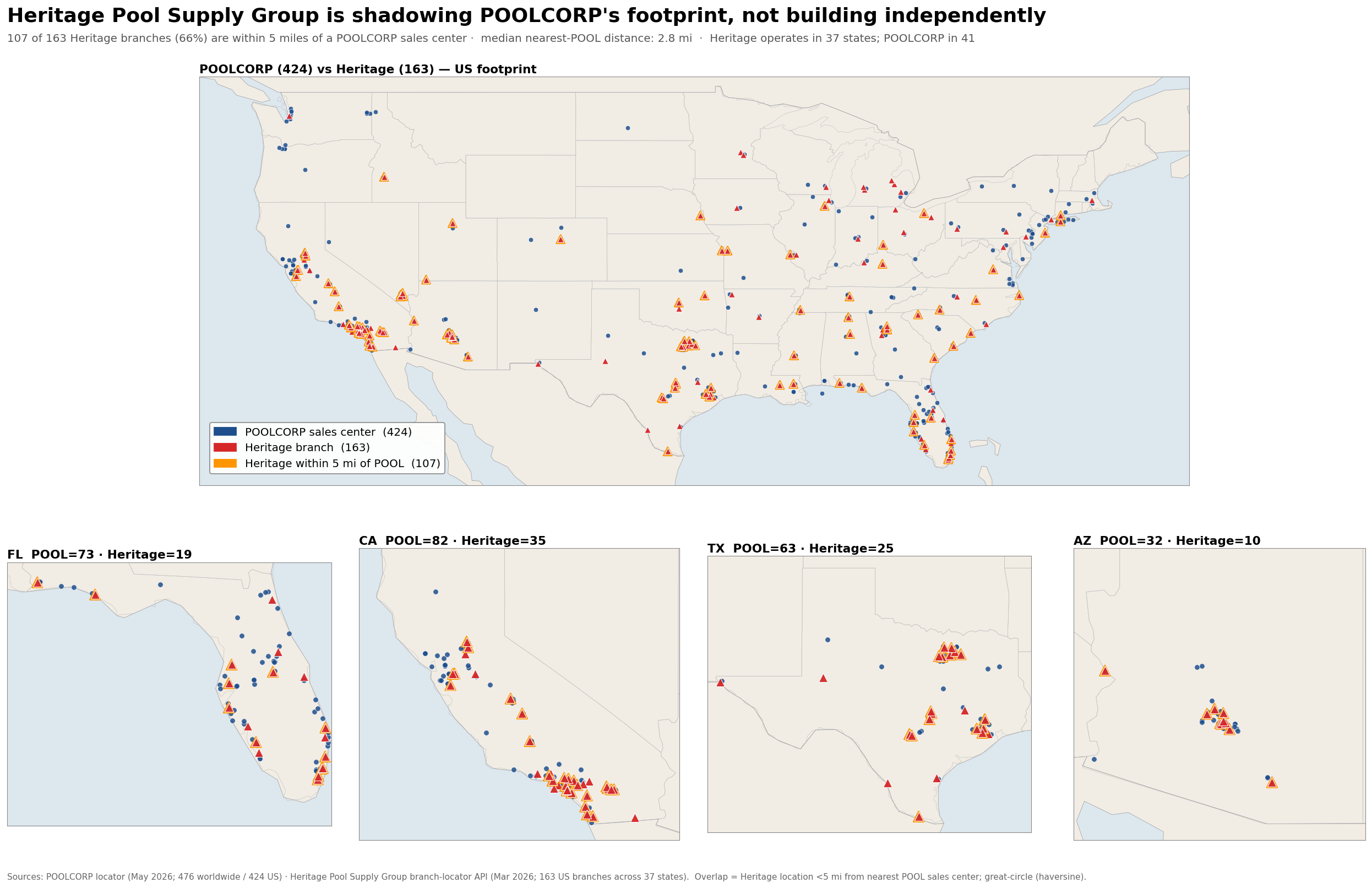
Emphatically following. Heritage is shadowing POOLCORP's footprint, not building independently. 107 of 163 Heritage branches (65.6%) sit within 5 miles of an existing POOL sales center; 84% are within 10 miles. The median Heritage branch is 2.78 miles from the nearest POOL location. Heritage operates in 37 states — every one of which POOL also serves — and there are zero Heritage-only states.
Source data: dashboards/pool_locations/heritage_overlap_metrics.json |
Findings doc: dashboards/pool_locations/HERITAGE_OVERLAP.md |
Scraped May 20, 2026 via scrape_heritage_xhr.py from the HPSG /api/branchList/features/ endpoint
● POOL locations (424) | ▲ Heritage locations (163) | toggle layers with the top-right control · click any marker for details
Right-skew is dramatic: more than 100 of 163 branches sit within 5 miles. The few >50mi outliers are pure white-space (8 branches: Laredo TX, Midland TX, Saginaw MI, Maui HI, etc.).
POOL-only states (4): OR (5 br), NM (1), ND (1), WV (1) = 8 branches total. Heritage-only states: 0. 10 states (mostly low-pool-density rural + AK/DC) have neither.
Heritage = 89 of 163 branches (55%) concentrate in the Sand States. 74% of those 89 are within 5 mi of a POOL — i.e. the share-shift threat is structurally aimed at POOL's most valuable geographic concentration. CA gap is widest at 82 POOL vs 35 Heritage (43% coverage ratio).
Heritage Pool Supply is the consolidated front-end brand (134 / 163 = 82%). The corporate-structure §2 from HERITAGE_CONTEXT.md lists ~12 brands; most appear consolidated into HPS in the API. Recreonics (1 in API vs national commercial network per acquisition press release) is under-represented — may operate under separate portal.
| State | POOL | Heritage | H/P ratio | Status |
|---|
Sortable rendering. Heritage/POOL ratio shows where Heritage has caught up most aggressively: HI is the standout (Heritage 4 vs POOL 2 = 200%) but POOL effectively wasn't there before the Island Pool & Spa acquisition. MI 5 vs 3, OH 5 vs 4, OK 4 vs 4 are other Heritage-overweight states. Heritage is meaningfully under-indexed in NY, NJ, NV vs POOL.
https://www.heritagepoolsupplygroup.com/api/branchList/features/ — Next.js API route returning a GeoJSON FeatureCollection (162 KB). No auth, no Cloudflare friction. Reproducible with plain Python requests.poolcorp.com/map_api/map.php (May 2026), filtered to US only (424 of 476 worldwide entries).dashboards/pool_locations/):
heritage_locations.csv (163 rows) ·
heritage_nearest_pool.csv (per-branch nearest pairing) ·
heritage_overlap_by_state.csv (51-row state table) ·
heritage_overlap_metrics.json (full numeric summary) ·
heritage_vs_poolcorp.png (static map) ·
heritage_locations.html (folium interactive — embedded above) ·
HERITAGE_OVERLAP.md (7-section findings doc) ·
plus scrapers in scrape_heritage_xhr.py, build_heritage_overlap.py, build_heritage_map.py, build_heritage_html_map.py